
Notary on the Upper East Side, at a glance
| What you want to know | The short answer |
|---|---|
| Mobile notary price | $125 flat anywhere on the Upper East Side, plus $2 per notarized signature |
| Hours | 7am to midnight, every day, Sundays and holidays included |
| How fast | Booked ahead, same day, or emergency in under 3 hours |
| Where | Your home, office, hospital room, nursing home or a cafe |
| Cheapest option | Your own bank, or a counter at up to $2 per signature, on weekdays |
| How to book | Book online or call (917) 203 9894 |
The Upper East Side has bank branches on nearly every avenue and several shipping stores with a notary on staff, so a simple signature on a weekday is easy to find. The harder cases are the ones this neighborhood produces most: estate documents that a bank will not touch, a signer in one of the hospitals along York Avenue, or a parent in a coop who should not have to travel. This page compares every option, including the free ones.
Where to get something notarized on the Upper East Side
If you can get to a counter, these are the main options in and near the neighborhood, and what each one will not do. Hours and staffing change, so call before you go.
| Option | Cost | When it works | What it will not do |
|---|---|---|---|
| Your bank or credit union | Free for account holders | Weekdays in branch hours, for simple documents; call first | Some refuse wills, powers of attorney or real estate papers; ask about witnesses |
| Shipping stores along Lexington, Third, Second and First Avenues | Up to $2 per signature, the New York cap | Store hours, when a notary is on shift; call first | Witnesses are not guaranteed; no home or hospital visits |
| NYPL Kips Bay Library, 446 Third Avenue | Free | Free pilot by online appointment, Monday mornings and Wednesday afternoons, two documents a day, English only | Same day requests, or document types outside its published list |
| New York County Clerk, 60 Centre Street, Room 141B | Free | Free, weekdays, up to five simple documents in English; call (646) 386 5932 first | Wills, trusts, deeds or anything that needs witnesses |
| Sealed NYC, at your door | $125 flat plus $2 per signature | Every day, 7am to midnight, anywhere on the Upper East Side | Only what New York notary law rules out; witnesses on request, $75 each |
The pattern is the same across the city. Free and low cost counters handle a simple signature in English on a weekday. They usually stop at wills, powers of attorney, deeds, witnesses and documents in other languages, and none of them travel. Our citywide guide to where to get something notarized in NYC has the full list with sources.
What a mobile notary costs on the Upper East Side
The Upper East Side is on our Manhattan price list, the same $125 as every other part of the borough, and the booking form shows the full total before you give a name or a card.
| Visit | Total on the Upper East Side |
|---|---|
| Standard, booked ahead | $125 + $2 per signature |
| Same day, 3 to 24 hours ahead | $165 + $2 per signature |
| Emergency, under 3 hours | $220 + $2 per signature |
| Evening after 8pm or weekend | add $50 |
| Hospital or nursing home | add $25 facility fee |
| Witness we bring | $75 each |
The $2 per signature is New York’s statutory notary fee, itemized on your receipt. Everything else is the flat visit price you saw when booking. A worked example: a power of attorney with two notarized signatures, booked a day ahead on a weekday afternoon, comes to $129. The same visit at 9pm comes to $179. Our guide to notary cost in NYC sets these prices beside banks, shipping stores and online notaries.
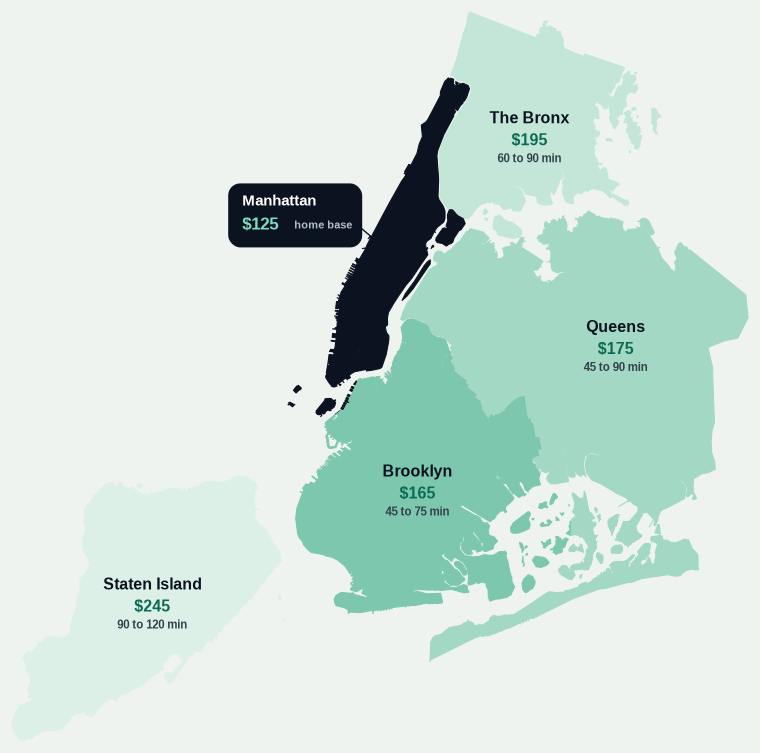
How a visit works
Booking takes about as long as ordering a car. You choose the borough and a time, see the total, and get a confirmed arrival window by text.

- Book. Pick a time online or call. Tell us how many signers there are, what kind of document it is, and whether it needs witnesses.
- We arrive. A commissioned, insured New York notary public comes to the address you gave on the Upper East Side, in business attire, inside the arrival window.
- ID and signing. Each signer shows a current government photo ID and signs in front of the notary. For an oath or an affidavit, the notary administers the oath first.
- Certificate and stamp. The notary completes the notarial certificate, signs it and stamps it. You keep the original, and your receipt itemizes every fee.
Where on the Upper East Side we come
Every block, at the same price:
- Lenox Hill: the 60s and 70s from Fifth Avenue to the river, including the hospital corridor on York Avenue.
- Carnegie Hill: the upper 80s and 90s near Fifth and Madison Avenues and Museum Mile.
- Yorkville: east of Third Avenue from 79th Street to 96th Street, along Second, First and York Avenues to Carl Schurz Park.
- Sutton Place and the upper 50s: the blocks just south of the Queensboro Bridge.
- Roosevelt Island: by tram or the F train, at the same Manhattan rate.
- Next door: East Harlem, Midtown East and the Upper West Side, all covered on our Manhattan page at the same price.
If your ZIP code is 10021, 10028, 10065, 10075, 10128 or 10044, you are in our Upper East Side area. The 4, 5 and 6 trains run under Lexington Avenue and the Q runs under Second Avenue, with the F at 63rd Street. Many buildings here have a doorman, so add the name the notary should give at the desk when you book, and any service entrance instructions your building has.
What the Upper East Side books most
Estate planning signings
Powers of attorney, health care proxies, trust documents and the self proving affidavit that goes with a will. These often need witnesses as well as a notary, and we can bring impartial witnesses for $75 each. The will itself is signed in front of witnesses and is not notarized.
Coop and condo paperwork
Board package affidavits, purchase and refinance closings, and the forms a managing agent wants notarized before a sale or a sublet.
Hospital and home visits for older signers
A signer who is recovering at home or in a hospital room can sign there. The notary confirms that the signer is aware of the document and willing before anything is stamped.
Documents for a consulate or an office abroad
Several consulates are in the neighborhood, including Italy on Park Avenue and France on Fifth Avenue. A document going to another country usually needs an apostille after the notary, covered below.
The East Side hospital corridor
Lenox Hill Hospital at 100 East 77th Street, NewYork Presbyterian Weill Cornell at 525 East 68th Street, Memorial Sloan Kettering at 1275 York Avenue and the Hospital for Special Surgery at 535 East 70th Street are all in the neighborhood. We come bedside at each of them and at rehab and nursing facilities nearby.
A bedside signing has the same rules as any other. The signer must be awake, aware of the document and willing to sign, and the notary confirms that before anything is stamped. If the signer cannot communicate with the notary directly on the day, the notary will not proceed. We can bring an impartial witness for $75, and a $25 facility fee covers check in and screening time. The hospital notary page covers ID, capacity and health care directives in full.
Documents headed abroad from the Upper East Side
If the document is going to another country, where it is going decides what happens after the notary. Countries in the Hague Apostille Convention accept an apostille from the New York Department of State. The rest need a Certificate of Authentication and then that country’s embassy or consulate. As of November 2026, according to the Hague Conference status table:
| Where it is going | What it needs after the notary |
|---|---|
| France, Italy, Germany, Switzerland and Spain | Apostille |
| United Kingdom and Ireland | Apostille |
| Israel | Apostille |
| Hungary and the Czech Republic | Apostille |
| Canada | Apostille, since January 11, 2024 |
| United Arab Emirates, Qatar and Kuwait | Not in the Convention: Certificate of Authentication, then the embassy or consulate |
See the full list of countries in the Hague Apostille Convention. The notary visit covers the notarization only. Our apostille service is a separate order: we take the document to the county clerk and the Department of State and courier it back, for $225 standard, $275 express or $425 next business day, plus government fees. Details are on our NYC apostille service page. A birth certificate follows a different route, explained in our birth certificate apostille guide.
One honest check before you book: if the papers are for a consulate, ask whether it wants you to sign at the consulate itself. Some consulates in New York witness signatures on their own forms, and then no notary is needed.
Same day, evenings and Sundays
Same day visits, booked 3 to 24 hours ahead, are $165, and emergency dispatch under 3 hours is $220. Evening slots run until midnight, seven days a week, for signers who only get home after work, and Sunday is a normal working day for us. Every booking gets a confirmed arrival window by text. If nothing on the calendar fits, call and we will tell you plainly whether we can make it. Our notary open now page shows who else is open at each hour of the day.
Need it today on the Upper East Side? See your exact price before you book.
Get your priceHow to prepare for your visit
- Photo ID for every signer: a current driver’s license, nondriver ID, passport or green card. The name on the ID should match the name on the document.
- The document complete but unsigned. Fill in every blank you can, and sign only in front of the notary.
- Witnesses, if the document needs them. Say so in the booking notes and we bring them. A witness should not be someone who benefits from the document.
- Everyone who is signing, present. The notary has to see each signer in person. A signature cannot be notarized for someone who is not there.
- Documents in French, Italian, German, Hebrew or Spanish or another language: tell us the language when you book. The notarial certificate we complete is in English, and many offices abroad also want a certified translation, so check with whoever receives it.
What a notary does, and what a notary does not do
A New York notary public verifies who is signing, watches the signature or takes the signer’s acknowledgment of it, administers an oath when the document calls for one, and completes a certificate saying so. That is the whole job, and it is what makes a bank, a court or an agency willing to rely on the signature.
A notary who is not an attorney does not draft documents, pick a form, fill in legal terms or say whether a document will do what you want. We will not notarize a document with blanks left open, a signer who has no acceptable ID, or a signer who seems unsure or pressured. A will is signed in front of witnesses and is not notarized; the notary’s part is the witnesses’ self proving affidavit. If you are not sure which document you need, the office asking for it or an attorney is the right place to ask, and our guide to what documents need to be notarized in New York lists the common ones.
The Upper East Side notary FAQs
How much does a notary cost on the Upper East Side?
At a shipping store or a bank counter, New York caps the notary fee at $2 per signature. A mobile visit from us is $125 flat anywhere on the Upper East Side, plus $2 per notarized signature. Same day visits are $165 and emergency visits under 3 hours are $220. Evenings after 8pm and weekends add $50.
Is there a free notary on the Upper East Side?
Your own bank is the closest free option if it offers notary service to account holders; call the branch first. The New York County Clerk at 60 Centre Street notarizes up to five simple documents in English for free on weekdays, and NYPL runs a free notary pilot at its Kips Bay Library at 446 Third Avenue by online appointment. No library branch on the Upper East Side itself offers notary service.
Do you cover Yorkville, Carnegie Hill and Roosevelt Island?
Yes. The whole Upper East Side and Roosevelt Island are covered at the same $125 flat Manhattan rate, with no surcharge above 86th Street or above 96th Street.
Can you come to Lenox Hill, Weill Cornell, HSS or Memorial Sloan Kettering?
Yes. We come bedside at all four. The signer must be awake, aware of the document and willing to sign, and a $25 facility fee covers check in and screening time.
My building has a doorman. What should I do?
Add the name to give at the desk when you book, and tell the doorman a notary is expected. If your building asks visitors to use a service entrance or show a certificate of insurance, say so in the booking notes.
Is there a notary open late or on Sunday on the Upper East Side?
Banks and the county clerk are closed then, and most counters stop notarizing when the notary on staff goes home. We come to you every day from 7am to midnight, Sundays and holidays included. Evenings after 8pm and weekends add $50 to the $125 rate.
What do I need to have ready?
A current government photo ID for every signer, and the document complete but unsigned. If the document needs witnesses, say so when you book and we can bring them for $75 each.
Can the notary tell me which form I need?
No. A New York notary who is not an attorney cannot give legal advice, choose a form for you or explain what a document will do. The office or attorney asking for the document is the right source for that. We verify identity, witness the signature and complete the notarial certificate.